You are here: »
Home » Posts filed under Michelin-starred
For a meal that eventually - thank God - managed to be worth the trip to Girona and then some, it couldn't have got off to a worse start. The first fifteen minutes of our lunch at El Cellar de Can Roca were blighted by "service" from a belligerent, monosyllabic waiter who spoke next-to-no English, threw our first few trays of amuses down with distracted haste and at one point, when I tried to ask him a question, actually turned his back on me mid-sentence and grumbled something under his breath as he walked off. This kind of thing is sadly quite common in Catalonia, but the last place you'd expect to find yourself emotionally battered and bruised is in the garden of a 3-Michelin-star restaurant recently voted the second best in the entire world. The guy shouldn't have been allowed to man a toll booth on the A-7, never mind wait on tables.
It took a timely intervention from another much more pleasant and capable member of staff (that's him above), then, to make us feel even welcome, least of all like we were enjoying ourselves. But eventually, after a brief tour of the glamorous Can Roca kitchens and a few glasses of Cava, nerves were settled. And through all the initial trauma, it has to be said, the food still shone. Like El Bulli three years ago (how time flies), the astonishing level of attention to detail and effort that went into every element of the 20+ different dishes was staggering, but unlike El Bulli, here there was nothing that was shocking for the sake of it or experimental to the point of inedible. And if you're thinking it seems odd to praise a 3-Michelin star restaurant for not serving inedible food, you haven't eaten at El Bulli.
The first thing diners are presented with at Can Roca is a spectacular bonsai olive tree hung with caramelised anchovy-stuffed olives. We were still suffering at the hands of El Bastardo by this point, so as our tree was slammed down one of the little olives detached and bounced onto the table. After it was (wordlessly and charmlessly) replaced, we enjoyed them as much as you can enjoy an caramelised olive-stuffed anchovy. Which is quite a bit, actually.
"Campari bonbon" were masterfully done - the cocoa butter casing was so delicate that the thing dissolved almost as soon as it touched the tongue, releasing a bitter, citrusy nectar. "Marinated mussels" were little blobs of seafood broth encased in some kind of edible (I hope) gel, and were similarly fun to eat. And there was a neat row of cylinders made from some kind of rice cracker, stuffed with blitzed calamari and topped with little nuggets of deep-fried, battered salmon eggs. I can't even begin to imagine the amount of work involved in making each these items, which disappeared down our greedy English throats in a matter of seconds.
Once shifted inside the stunning, Zen-like restaurant and safely away from the influence of El Bastardo, we were presented with what they described as a "mushroom brioche" but was more like a Chinese-style har gau dumpling casing, injected with a powerfully truffly mushroom paste. It probably took some poor bugger about three weeks to make.
And if all the above is impressive, the next amuse (we hadn't even got to the first starter on the tasting menu yet) made me want to go and give everyone involved in making it a hug, partly in thanks and partly in sympathy. Dubbed El Mundo (The World), it consisted of five exquisitely prepared morsels, each inspired by a different country. We were asked to guess which was which, and although the sashimi & rice of Japan was fairly obvious, as were the Asian herbs in the astonishing Thailand (a similar technique to the Campari bonbon, fish stock inside a thin casing), I managed to mix up Morocco, Peru and Mexico somehow. All of them tasted great though.
Finally, our first course. "Oyster with black pearl, wrapped in its own juice" is a rather inelegant translation of an extremely elegant dish. Pickled vegetables of various kinds (the celery was particularly good), and I think a melon sorbet, accompanied a meaty bivalve that had been treated in who the hell knows how many different chef-torturing techniques to give it extra flavour and texture. I didn't know there was anything you could do to a raw oyster to improve it other than sprinkle it with Tabasco, but now I do.
"Green wheat with smoked sardine" came with "toasted bread ice cream" which I've decided is my new favourite ice cream. The sardines were strongly flavoured and the smoked fish and grapes worked brilliantly. Nice presentation, too - in an indent carved out of a thick stone slab.
"Olive paste" was a kind of thick gazpacho studded with various different preparations of olive. That description doesn't really do it justice, because this unlikely thing was one of the highlights of the entire meal. There was something strangely beguiling about the way all the various types of olives (Gordal, black and Manzanilla) combined in the mouth; the little black olive fritter in particular was incredibly intense.
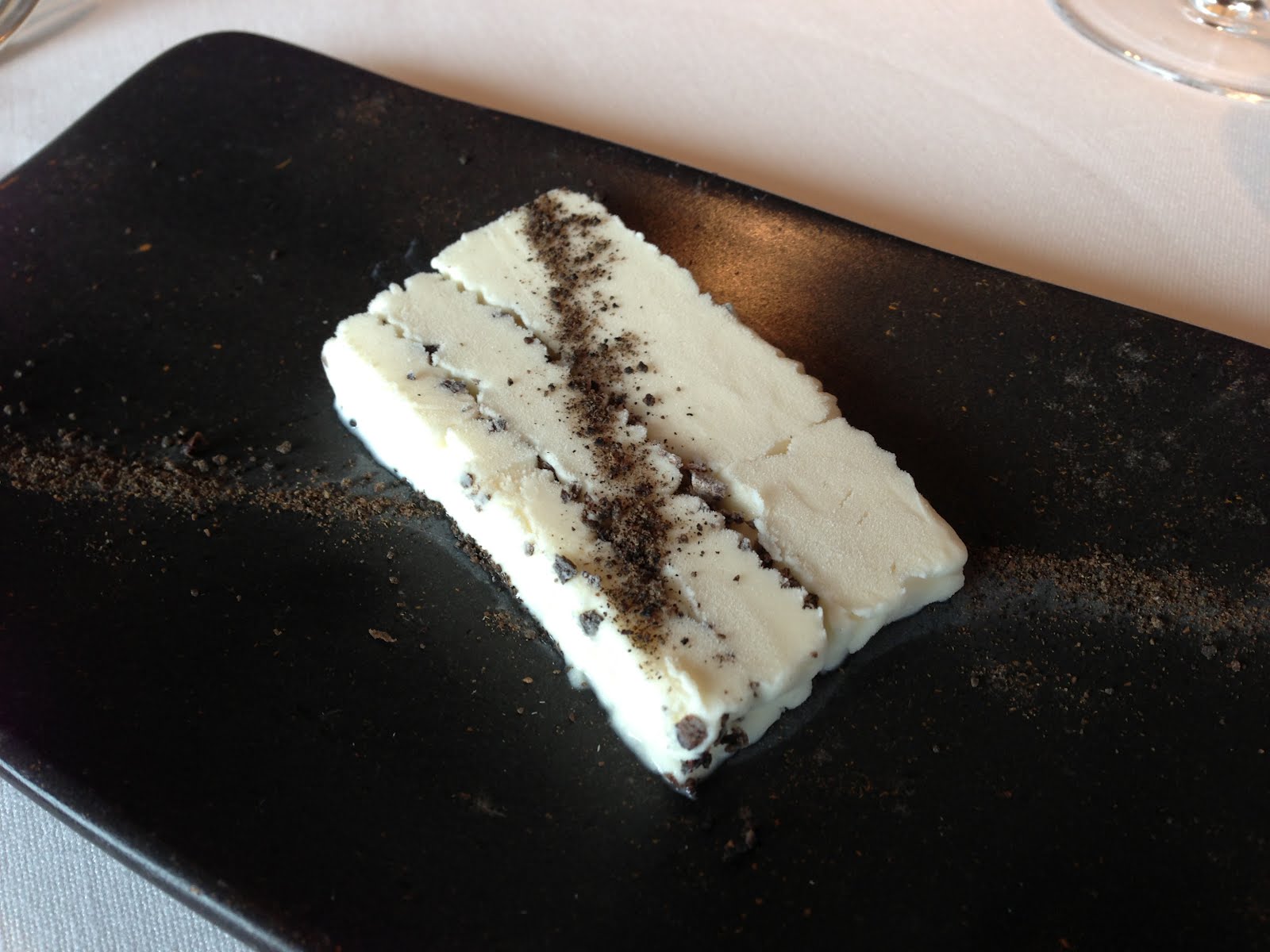
"White asparagus Comtesse" was as hilarious as it was delicious - "Comtesse" is the Spanish brand name for Wall's Vienetta, and you can see the similarity here. It had a simply stunning flavour, creamy and savoury, shot through with black truffle. Another highlight.
And then, the famous Can Roca king prawn dish, and I'm afraid my meagre writing skills are going to fall hopelessly short in conveying just how utterly magical this was. On the one hand, it's a deconstructed prawn, with the head and legs freeze-dried and deep-fried (somehow), a sauce made out of the head juice (somehow) and then (somehow) the tail meat infused with chargrilled flavour without drying them out. But the results were mind-blowing, like every prawn I'd ever eaten in my life was just leading up to this moment. The tail meat was soft and sweet and smoky, the head and legs deeply savoury and salty and greaseless, the sauce rich and just the right side of bitter. If I'd paid €165 for just this one dish I'm not sure I'd have cause to complain. Unbelievably - literally unbelievably - good. I'm still in awe.
A dainty little fillet of bream was surrounded by an arc of vegetables treated in various different chef-tortury ways. The vegetables, really, were the highlight - all kinds of things going on and it was fun working your way through them to see which were pickled, which were raw, which were grilled, etc. The fish was pleasant but I'm afraid I do miss a crispy skin - you can probably tell from the photo that it was a bit... gelatinous, and gelatinous isn't the first thing I look for in a good piece of fish.
"Salt-cod brandade" was an experimental but otherwise pretty much perfect fish soup. Not being much of a cook myself I couldn't tell you exactly what they'd done that was so right here, but the broth had a deeply satisfying flavour of fish stock, and the bacalao itself was soft and refined.
These little cubes of Iberico belly pork, each with an expertly-judged amount of fat and meat, were surrounded by a variety of colourful fruit and veg and were, of course, perfect. By this point we were enjoying ourselves so much (helped I'm sure by some incredibly good wines from possibly the best value 3 Michelin star wine list in the world - I can particularly recommend the Blancs del Aspres '09 for €19.50) the chef-guilt factor had been put to one side, but going through the menu again now I'm noticing with horror that the 'fruit and veg' I dismissively referred to are in fact eight different preparations of mango, melon, beetroot, black garlic, onion and orange. They probably cost someone their mental health.
"Red mullet cooked at a low temperature" was presented in a gorgeous scarlet-red sauce and with three towers of fruit-flavoured... things, one of which I think was grapefruit. The fish itself, as you might expect, had a great flavour but again I'd have preferred a more traditional technique and a crispy skin. But maybe that's just me.
"Charcoal-grilled lamb breast" was presented theatrically under a glass dome filled with BBQ smoke, a nice touch. The lamb was excellent, a neat little square of just-so meat, not too fatty and retaining some bite. A sweetbread was similarly expertly done, crispy on the outside and juicy within. I'm glad I didn't detect much of the advertised liquorice in the sauce, though. I don't hold with liquorice in food at the best of times.
"Wood pigeon liver and onion" was another masterclass in making the most of great ingredients. The "liver" just looked and tasted like a normal bit of pigeon breast to me, but that's hardly a criticism, and the curry-caramelized walnuts were the kind of thing I could eat a kilo of in one sitting - that is, if they didn't take a team of trained chefs four days to make (I assume). Lovely orangey tang to the sauce, too.
First of the desserts was this arty arrangement of "Maple syrup cream with pear, hazelnut and cardamom". Very pleasant but I'm afraid just slightly lacking next to the theatrics of earlier dishes.
All the desserts were a bit subdued, in fact. This caramelised apple was little more than sugar wrapped around sugar sitting on top of sugar. It looked impressive, but the savoury courses had matched stunning visuals with equally stunning flavours.
"Moka millefeuille" was probably the best of the desserts, all crispy and soft and not as overwhelmingly sweet as the first two. But it was still only "very good" where earlier dishes had been world-beating. I wonder if this had anything to do with Jordi Roca, the brother who normally heads the pastry section, being out of the country on a conference? Not an excuse, but an explanation perhaps.
And after a selection of fairly uninteresting chocolates and madeleines presented on a tray that looked like a flattened Rubik's Magic, we were done. The relatively unexciting desserts (not to mention early service catastrophes) weren't enough to take the glow off what had been, by and large, a truly exceptional meal, from some uniquely gifted chefs. Can Roca is worth visiting for nothing more than to gasp in open-mouthed awe at the amount of time and skill and creative energies that have gone into every element of the menu, and although it's not cheap (the bill came to €200/head give or take) in the context of what they have achieved it's something approaching a bargain. And so, in short, if you have the means, you should go. The Roca brothers will be waiting for you. El Bastardo - with any luck - will not.
8/10
For many years, the cliff-top road to El Bulli was uneven, unpaved and, frankly, terrifying. Difficult enough even today despite clear road markings and that thick black tarmac the Europeans seem to do so well, for all the time Ferran Adria was collecting his stars his guests (not to mention countless Michelin inspectors) were required to pass this rally trial of a journey before they were allowed to sit down to dinner.
Of course, it was entirely deliberate. The bumpy journey around the coast, that half-hour spent bracing for every pothole, hoping to God you weren't about to hit a stray rock and career off into the Bay of Rosas, was all part of the adventure, the idea presumably being that the harder you had to try to get to a restaurant, the more likely you were to make the most of it once you got there. Whatever you thought of his food (and I didn't think much), Adria is nothing if not a showman, and understands that anticipation and the sense of achievement of having "arrived" (all coupled with the desperate unlikelihood of securing a reservation in the first place of course) is absolutely the best way of ensuring your guests are in the best possible frame of mind to be entertained.
On a smaller scale, building any mini break or long journey around a single meal goes some way to generating that sense of anticipation. Admittedly, Cartmel isn't quite as far-flung as Cala Montjoi, and turning left off the A590 isn't as spectacular as navigating a precipitous coastal road 200 metres above the Mediterranean sea, but the idea is the same - you're making a journey for your dinner, you are removing yourself from your daily patterns and routines and embarking on an adventure. We essentially weren't travelling up to the Lake District for any other reason than to eat at l'Enclume, and so the journey, indeed the whole trip, became part of the meal. And it follows, of course, that had the meal been disappointing, so would the trip.
Fortunately, Saturday evening in l'Enclume turned out to be one of the greatest meals I've ever had in my life. I have been thinking hard (usually a mistake) about whether if I'd just got the tube to Mayfair and had the same food and service would I still be in such raptures; on the one hand it doesn't matter I suppose as it's just pointless speculation, but are all truly great meals just as much a product of build-up and state-of-mind and surroundings as they are of skill in the kitchen? Is l'Enclume really serving the best food in Britain or was it simply a result of a "holiday mode" mental state and a pretty sunlit garden next to a babbling brook? See if you can help me decide.
From an array of amuses that arrived more or less together, the least impressive was actually the only thing in the whole evening I recognised from the l'Enclume sister restaurant in London, Roganic. "Cream cheese wafers" were as pretty as an entry in the Chelsea Flower Show but tasted only "very good". Smoked eel cooked in ham fat tasted every bit as good as that combination sounds, "Celery and apple and pickled beetroot", a substitution for my red-meat-avoiding father was a little explosion of fresh summer produce, and "peas and beef tongue" suffered only slightly from underseasoning but nevertheless was great fun to eat thanks to a range of interesting textures.
Out in front, though, was something called "Oyster pebbles"; supremely delicate apple meringue filled with oyster cream which dissolved into heavenly fresh seafood in the mouth, accompanied by extraordinary things called "oyster leaves" - look like weeds, taste like oyster. Really.
First proper course was an achingly pretty arrangement of sliced kohlrabi, puffed wild rice and what looked like a bright yellow quails egg but what was actually cod & sage cream set inside a gel of some kind. L'Enclume is not averse to using the odd bit of scientific trickery, it seems, but only sparingly, and always to great effect. Some powerfully-flavoured pieces of tomato added extra umami, although if you are (understandably) wincing at the unironic use of the word "umami" in a restaurant review, feel free to substitute it for "tomatoey flavour".
I should probably pause to make a special mention of the house bread. There were three kinds - a pumpernickel, an onion whole-wheat of some kind and a white flavoured with summer herbs, and were so good with the bright-white salted house butter it was a constant struggle to stop working your way through them. They were fresh out of the oven, with perfect crusts and soft moist inside, and I have not had better house bread anywhere apart from sister restaurant Roganic. Alaine Ducasse once said, when confronted with a criticism that his house bread was cold, that he didn't want people to "fill up" before the proper food started arriving. Well, Ducasse is a fool and l'Enclume is proof that a tray of the greatest bread in Britain only adds to the enjoyment of a meal. We do have some self-control, you know.
Westcombe [Cheddar] dumplings in onion broth, marjoram and broad beans was nothing short of sensational. The flavour from the dumplings was as good as you might expect from this magisterial unpasteurised product, but the syrupy onion broth paired with tiny leaves of intense marjoram turned the whole thing into a sort of God's Own French Onion soup.
I have long suspected that venison makes a better tartare than beef, and nothing on this plate was about to change my mind. Studded with delicate tiny cubes of capers and dressed with fennel shoots, the venison still managed to be the star of the show despite jewelled pockets of sugared fennel bursting on the tongue and providing wildly inventive seasoning and texture.
Scallops (usefully described as "sea scallops" on the menu, marking them apart from the tasteless land-dwelling variety you see so many of these days, as someone sarkily pointed out on Twitter) came dressed with a sharp strawberry sauce, crunchy grilled cauliflower and a selection of foraged coastal herbs that seasoned with intense sea-salt flavours. There was also a little dollop of what I think was some kind of hazelnut purée, and a scattering of puffed oats.
We were fortunate enough to eat at l'Enclume on the same day as their restaurant farm had pulled up its first harvest potatoes. These innocent looking tubers managed to punch through as a main ingredient despite being served with citrusy Nasturtium leaves and delicate slivers of chicken skin, and were as rich - and enjoyable - as any protein.
Next, a disc of charred cucumber and some kind of crispy shoot of broccoli was scattered with local shrimp and a blackberry oil dressing. The shrimp, as you might hope, were the talking point - sweet and juicy and almost unnaturally powerful in flavour, but the same attention to detail and artistic sensibility had been applied to everything else on the plate.
I'm going to just take a moment here and say that those previous five courses, from the onion broth to the local bay shrimps, constitutes the most consistently brilliant run of dishes I've ever had the pleasure of eating. Inevitably any meal has highlights, but it's very rare indeed to see so many side-by-side that are as good as can possibly be, that each impress in every way just as much as the one before, and that maintain such a stunning level of precision and skill. These dishes are side one of Van Morrison's Moondance, the first ten minutes of Disney/Pixar's Up - crafted, expertly judged, perfect.
That the next course didn't quite live up to the previous giddying highs is not that much of a criticism. Local bass was full of fresh flavour and cooked to just translucent, but the topping of shockingly fishy cockles on top dominated far too much, and rather threw the whole thing out of kilter. We also had to Google what a "chenopodium" was (looks like mint, tastes of salad).
We were, though, right back on top of the mountain with this suckling pig. Dressed with yellow beans and wood sorrel, the crackling took the form of piggy popcorn, presumably dried and deep-fried pieces of pig skin. The pork itself was unbelievably tender and moist, and I'm afraid I rather embarrassed myself by sweeping up every last remnant of the sauce with my fingers, it was that addictive.
Cheeses were all British Isles and largely very good although in all honesty I was a bit underwhelmed by a couple of the soft goat's. In principle I applaud the idea of extending the fiercly localist principles of l'Enclume to the cheeseboard, I just think - and believe me it pains me to say this - that sometimes the French do certain types of cheese better. At least, for now.
Iced chamomile, spruce, celery and black pepper was a palate-cleanser but memorable enough in its own right. Chamomile is an interesting flavour and, in common with pretty much everything else we at at l'Enclume, the combination of these ingredients wasn't something I'd ever had before.
"Cumbrian slate" was in fact two portions of summer berry jelly dusted and shaped to look like lumps of rock. Lemon verbena were placed like shoots of ferns growing in between the rocks, and the apple and gooseberries were freeze-dried and aerated somehow into little moss-like sponges. Clever stuff, and of course, very tasty.
There's not much not to like about the combination of cherries, hazelnut and cider, and yet another supreme command of texture and technique made this something special. I particularly liked the hazelnut, which was whipped into a kind of light mousse.
Finally, journey's end. Oatmeal stout, blackberry, malt and plum was a sandwich of light malty mousse topped with blackberries and served alongside a little cup of plum sauce. We'd had fully fifteen courses before it, and yet it still disappeared with relish and enthusiasm.
So what do you think? To return to an earlier point, running back through the l'Enclume menu now I can't imagine the setting and state of mind had much to do with the fact we enjoyed ourselves so much; it was simply that presentation, ingredients, attention to detail and monumental effort had produced a dinner that stood apart from pretty much anything else we'd ever eaten.
No element of any dish was superfluous, no fancy cheffy technique was either overused or there simply to hollowly impress at the expense of culinary sense. The food was never obscure or superior; where it was challenging it only ever delighted and surprised, never confused; where it used foraged or unusual ingredients they always worked better than any conceivable alternative, and were not just present to prove a point on sustainability. The service was professional and knowledgeable but never aloof, the timing between courses always just right - the first few dishes appearing swiftly in sympathy with our empty stomachs, then slowing down as the meal wore on. Yes, there were a couple of things we enjoyed less but these weren't jarring errors, just differences of opinion perhaps, and I suppose £89 a head isn't an everyday spend but is still perfectly within the bounds of acceptability for this level of cooking.
I'm not the first person to rave about l'Enclume and I certainly won't be the last. And I won't insult their kitchen by labelling anyone a "genius"; that word has lost all meaning after being thrown at anyone who's ever lifted a knife and who very rarely deserves it - certainly not Ferran Adria who I've always considered to be more PT Barnum than Pablo Picasso. So the greatest compliment I can give Simon Rogan and Mark Birchall and the phalanx of talent behind the stoves in the old Smithy in Cartmel is that I don't think there is any more exciting, innovative, joyful and miraculous restaurant in Britain. L'Enclume is an open-hearted and masterful celebration of everything that's great about modern British food, and you should go as soon as you possibly can.
10/10


Who'd be a chef? The long hours of backbreaking toil for next to no money, the abuse, the heat, the stress. I've often heard it said of food bloggers and restaurant reviewers that they all-too-easily criticise a meal without knowing the effort that goes into it, but actually if most of us really truly understood the herculean energy behind even a half-decent meal out, we'd just feel too guilty to enjoy any of it never mind write an honest review.
I was reminded of this while reading Alex Watts' hugely entertaining book Down And Out In Padstow And London, and in particular the chapter at the Fat Duck where he describes spending days on end painstakingly removing the individual cells from grapefruit flesh using tweezers. The grapefruit cells formed just a small part of a salmon and liquorish dish, which I vaguely remember hoovering up as part of my tasting menu a year or two ago without giving them even a second glance. Had I known then what I know now I would have not only have appreciated them a whole lot more, or at least noticed them for God's sake, but also asked to give the poor commis chef lumbered with this frankly ludicrous task a big hug.
Of course, I blame Michelin (well, it saves time). It's thanks to their spoddy obsession with technique and classical presentation that many chefs feel they have to put themselves through 12-16 hour days of absolute hell turning vegetables into neat little cylinders and creating mind-bogglingly complex sauces from twelve different types of stock. I've heard stories (from Alex's book, and elsewhere) about chefs being physically unable to eat the kind of food they produce because the association with the backbreaking toil is so traumatising. To those people working their way through Michelin-starred hotel restaurants that really are cooking the kind of food they want to cook and want to eat, good luck to you. To the rest, you have my deepest, heartfelt sympathies.

Which brings us to Roux at the Landau. In the light of the above, I'd like to say to the overworked, traumatised phalanx of underappreciated chefs working in the kitchens at the Langham hotel that I'm desperately sorry I didn't enjoy the food more than I did. I'm sorry I thought the taramasalata that came with the house chips was too salty, I'm sorry I couldn't help noticing the limp sprig of tarragon slowly wilting into the overheated plate with the scallop, and I'm sorry I thought the Iberico pork chop tasted as bland and watery as any supermarket pig. I really am so very, very sorry.

It wasn't all bad, though. The scallop itself, despite being presented strangely and slightly underseasoned, was huge and had a lovely fresh, sweet flavour. My starter of "Venison and foie gras Chausson" was actually just a posh mini venison pie, and had a commendably powerful gamey flavour and aroma; it came with a madeira jus which probably took someone weeks to make and was silky and rich as only the best classical French cooking can be. And while my rhubarb panacotta was perfectly pleasant, we were particularly impressed with two delicate sticks of salty, buttery pastry placed on top - hugely addictive.

But I can't ignore that awful pork, so insipid I'd question whether the producer should even be allowed to describe it as Iberico. And neither my friend's Pot au Feu containing chewy, dry beef and so lacking in taste she found herself grinding salt over it in an attempt to find something to enjoy. It was all presented immaculately and I'm sure took years of experience and days of preparation, but it all was curiously missing some vital element - heart? Passion? It's easy to sail dangerously close to pretention when talking about a plate of food as "passionate" but it all seemed a bit hotel-restaurant Michelin-by-the-books - solid, professional, dull.

It doesn't have to be like this. Some people are lucky enough to not only cook the kind of food they want to cook, but cook the kind of food they want to eat - take the boys at Pitt Cue for example, banging out sticky trays of meltingly tender St Louis ribs and heavenly burnt-end mash from a tiny kitchen in Soho. Classically trained in a number of high-profile and high-price-tag restaurants, they have found huge success in homestyle American BBQ because this is what they want to do. And it's not just the trendy low-budget places; I have enjoyed every single thing I've ever eaten at Racine in Knightsbridge probably because the menu is a hymn to one man's (head chef Henry Harris) lifelong love of bourgeois French cooking.

So I don't blame the chefs at Roux at the Landau. They are doing a difficult job in difficult circumstances and couldn't really have done any better. Partly I blame the stultifying atmosphere of a hotel restaurant, and the timid adherence to the expectations of fusty regulars - like the old chap on the table behind us who turned up for dinner alone and so drunk he could barely string an order together for his poor waiter. And partly I blame the whole Roux estate who are attempting to farm out this anonymous hotel-friendly cuisine all over London (see also Parliament Square) in an effort to be the next Ducasse or Ramsay (as if the world needs yet another one of either of those). But mainly, I blame the passion-clogging, soul-destroying, talent-robbing Michelin Guide.
5/10

Murky, shonky pictures of the food are mine; nice bright interior shot courtesy of Fluid London. I was invited to Roux at the Landau, but prices are here