You are here: »
Home » Posts filed under islington
Back in April, I went to a brand-new restaurant in Fitzrovia called Dabbous. I had a lovely lunch with three friends, paid a very reasonable amount of money for it, and left very happy indeed. For some months since I raved about it any chance I could get and it wasn't long before I returned with a different group of people eager to fall in love with the place all over again.
That didn't happen. Instead, this happened. The wonderful cold allium dish from April had been replaced by a slice of ordinary tomato in a sweet consommé of some kind. The coddled egg had gone from being a beguiling, rich mixture of smoke and herbs to a nothing much more than thin scrambled egg. And the Iberico pork tasted of nothing, the acorn dressing that worked so well the first time now reminding me of cheap satay sauce. Bits and pieces of it were still enjoyable (the house bread was still excellent) but how to explain such a different meal? I couldn't honestly put my hand on my heart and say that any of the dishes I'd enjoyed the first time and now didn't were objectively any different this time at all. Either they'd changed, or I had. And I have absolutely no way of knowing which.
And it's this mysterious, intangible variation in the restaurant experience from one day to the next that makes writing about these places so difficult. Every fibre of my being tells me that upstairs at John Salt is the most exciting, innovative and enjoyable place to have dinner in London right now, and yet I'm worried if I go out of my way to say so, I'll be on the receiving end of a dozen disgruntled comments at the end of the month when for whatever bloody reason various other people are disappointed by it. But for the sake of argument I'm going to ignore that possibility for now, and hope that just for once I may have got this one right.
Given a notable recent trend for hacking tube maps (and I plead guilty myself in that regard), the minimalist menu upstairs at John Salt is very "now", with the option of a £56 4-course 'Central Line' (actually 7 if you include the extra bits and pieces) or the full 12-course 'Piccadilly Line' if you have £85 burning a hole in your pocket and feel like travelling all the way to a culinary Cockfosters.
The terse descriptions on the menu/map, though, seriously undersell the amount of detail in the dishes themselves. 'Nibbles', for example, was a tray containing five different elements including a sort of slow-cooked beef croquette speared on an egg whisk, a lemon curd-like substance sprinkled with nuts (slightly unusual amongst savoury items I suppose but there it was anyway) and a incredibly lovely dashi soup poured from a miniature teapot. I know enough about Ben Spalding that anything described as 'nibbles' would never have been a bowl of Twiglets but these were beyond the call of duty.
House bread normally isn't worthy of a course to itself on a menu, but house bread is rarely as good as this. The in-house baker Fanny came out to explain what we were being given, my favourite being a little muffin-shaped red wine bread with a fantastic crust. More impressive still was the gluten-free option served to my dining companion that evening who said it was the best gluten-free bread he'd ever had - not exactly a crowded field, admittedly, but still nice to hear. And even the butter was special - from Norway I believe, served as it arrived as well as soured and whipped with sugar.
I didn't "get" the inspiration for Chicken on a Brick until a couple of days after my meal at John Salt when someone explained that Conran Shops used to sell something called 'Chicken in a brick', a sort of big ceramic roasting chamber. Anyway you didn't need to be in on the joke to enjoy this fresh chicken liver paté spread on top of solid, sticky caramel. We were told to "lick the brick". I didn't need telling twice.
Maple-smoked wild salmon was very good, the salmon itself not being overwhelmed by the maple flavour and having a great healthy, solid texture of wild animal.
I completely forgot to take a photo of the dish called "salad" but as you can see from the quality of the other photos, you're not missing much. Imagine a painfully pretty arc of a bewildering number - over 50 in all - of vegetables, some foraged, some pickled, some preserved, some cooked. They left us with the full list (colour-coded according to preparation method) and I think I noticed about 1/10 of them while eating, but it was great fun. Can Roca in Girona used to do a dessert called 'Anarchy' which contained 50 different elements; this may have been a savoury tribute to that or their own invention entirely.
"Beef heel" was a stonking dish, a lump of gooey slow-cooked cow dressed with button mushrooms, matchstick root vegetables of some kind and little mounds of buttery kale. The sauce was an un-filtered dollop of the cooking sauce from the beef, and the little bits of crispy fat and crunchy herbs from the beef seasoning were a great addition to the mix. Perhaps the most traditional dish in terms of flavour combinations but little tricks with texture and form turned it into something special.
"Cucumber and peanut butter" did, fair play to them, taste of exactly that, and it's a combination that while genuinely innovative I'm not sure I'd rush to try again. My companion loved it though so there's every chance you will too.
As the final dessert I was served this absolutely incredible yoghurty thing which I completely forgot to take any notes for and can't elaborate on at all other to say it was a) yoghurty and b) incredible. AA Gill eat your heart out.
And other than a final little chocolate petit four, that was it. I've wittered on long enough and by now you will have realised that John Salt is already one of my highlights of 2012, but two final things remain to be said:
Firstly, the staff at were all, with no exceptions, some of the best front of house (even when they were in fact, back of house… job roles are somewhat blurred in this place) I've encountered anywhere. You can dismiss it as a gimmick if you like but having the pleasant, passionate person who put together the 50-element salad come out and explain the reasoning behind it before you tuck in is a privilege and a joy.
Secondly, it's hard in a few short paragraphs to emphasise just how much fun it all is - we've heard promises before about 'haute cuisine but without the attitude', 'fine dining in trainers', and so on but it seemed to me that Ben Spalding has hit upon a genuinely new way of doing things here - with so much going on and with so much blurring of the lines between waiter and chef, you feel like you're part of some community, a culinary interactive theatre where each actor plays an equally important part and wants nothing more than for you to enjoy yourself. Viajante may claim they were the first in London to have the chefs come out and present their dishes but I always felt they did so under duress; at John Salt they bound out with a huge smile on their face, eloquently and clearly explain the deal then leave you to enjoy it. It's all quite wonderful.
To return to the opening theme, John Salt is already suffering from the Dabbous Effect in one regard - it's increasingly difficult to get a table. But I'm confident this time that the Emperor has all his clothes, hype played no significant part in anything I rated about the meal, and if you manage to get yourself a booking at you will enjoy it all just as much as I did. And if I'm wrong and you hate it, well, then I know nothing about such things after all. But at least it was fun while it lasted.
9/10


The evening had hardly got off to an auspicious start. Forced to leave our cosy, dry table at the Mucky Pup (aptly named as it seemed home to every noisy dog in North London) in search of sustenance, we set out on the trail of somewhere called the Sultan Ahmet, reportedly one of the oldest Turkish restaurants in London and purveyors of top charcoal-grilled kebabs. At least, that was the plan. The heavens opened, the Sultan Ahmet was closed for Ramadan, and not wanting to walk any further in the rain, we sploshed on to an Eritrean place literally next door. Bitter experience has taught me that very few places chosen on availability alone and without prior research end up being any good, and so it was a very dubious, not to mention hungry and wet, group of people that sat down in Zigni House last night.
My only other experience of Eritrean food was in Asmara in Brixton a year or two back. It was nice enough, from memory; I remember leaving happy and sated and financially not hugely worse off, but it's fair to say I haven't been itching to go back. None of the different stews seemed particularly interesting or distinct, and all just merged together into one homogonous brown paste - literally, in fact, once they'd all been dumped on the same huge tray of injera. So my hopes weren't sky high for Zigni House, particularly once we'd negotiated the rather listless front of house and found a table in the empty dining room. But things started looking up once the food arrived.

Starters of timtimo rolls and kategna were excellent. The rolls were soft and sour and contained a lovely dense filling of lentils, sort of a thick Eritrean dhal. And the kategna turned out to be delicate crispy squares of fried injera sprinkled with chilli powder - whether it was the ghee or the bread I'm not sure, but these tasted rather like crunchy slices of cheese on toast. Which of course can never be a bad thing.

For mains, and mindful of the homogonous brown paste we accidentally ended up with at Asmara, we made a conscious decision to order a selection of the most diverse-sounding dishes on the menu. What arrived was Quanta Fit-Fit, a delicious concoction consisting of dried beef cooked in the house chilli sauce and mixed up with a few pieces of the ubiquitous injera; Dulet - powerfully flavoured lamb tripe mixed with garlic, chilli and fresh herbs; Zil-Zil - tough but tasty biltong-like strips of blackened cured beef shoulder in a drier spicy paste; and a side portion of the house yogurt, presumably home made because it was as light and fresh as whipped cream and tasted divine. It was all incredibly good, and disappeared in record time, even necessitating an extra order of injera as there was so much of it to scoop up.

There were some issues with Zigni House, I suppose. Service was slow and reclusive - just one guy who spent most of his time hiding out of sight in the bar and had there been more than two tables occupied all evening I imagine he would have struggled. And we had to switch tables after the attractive-looking more informal sofa and raffia pedestal arrangements turned out to be painful and impractical to eat at. But other than that, I can't see why any patient person wouldn't enjoy a meal here - even the vegetarian options looked interesting and judging by the lentil starter I'm sure would have tasted great. Towards the end of our meal (which came to a very reasonable £20 or so a head including a bottle of wine between three), we were engaged in conversation by the fiercely knowledgeable owner Tsige Haile, who I have learned since is considered somewhat of an authority on Eritrean food and a celebrity chef in her native country. We gave our honest and gushing feedback on the meal and she seemed pleased enough, as you might expect. Our unplanned visit, salvaged from the jaws of disaster, turned out to be a minor triumph.
8/10
Apologies for the dreadful pictures. I think my hands were covered in Zigni sauce and I couldn't hold my iPhone still


Well blow me down, but if London doesn't seem to be all of a sudden getting the hang of Italian restaurants. First Zucca, an astonishing eatery in Bermondsey (of all places) which blazed a trail for fresh, affordable food and proved that the only options for Italians in London didn't have to be (heave) Zizzi's or (ouch) Aspley's. And now Trullo graces another otherwise unloved area of town with its stunningly tasty food at very reasonable prices, setting up shop just off Highbury Corner. I may not be the first to discover Trullo - as ever, that accolade goes to the always on-the-ball Majumdar brothers - but I left last night, after a delightful meal, its latest devotee.


Prices on the concise Trullo menu aren't quite as low as they were at Zucca, but then the opening £4 starters in Bermondsey didn't last long anyway - recent visitors have discovered everything bumped up a bit. Even here though, you could hardly complain. Starters and the pasta courses came in around £6-£7, and main courses £14-£15; good, solid mid-range restaurant prices and nothing to immediately either raise the hackles or raise suspicions. I did think "chorizo and Padron peppers" wasn't exactly the most Italian sounding dish in the world, but then let's not forget we're sat next to a busy high street in N1 and not in a remote farmhouse in Puglia. Strict authenticity can take a back seat to a bloody good meal, in my opinion.


The chorizo and padron peppers dish was accompanied by some juicy slices of ox heart, and was splendid. The heart was tender (a notable achievement) and had just the right level of offal tang; chorizo was as good as chorizo is, and oozed with salty red oil with every bite; the only slight disappointment was that none of the padron peppers were hot, but they couldn't have done anything about that. But even this dish paled into comparison to my companion's "Braised cuttlefish with Datterini tomatoes and basil", which was by some way the tastiest squid recipe I've had anywhere in... well, I don't know how long. Gorgeous tender pieces of squid nestled in a heady, herby vegetable sauce which complimented and accented the seafood without masking it. Lovely.

The next food to arrive on our table should have been the ravioli, but due to a mix-up in the kitchens (partly due to the no-show of the fish man and my request that we'd prefer to have the brown shrimp taglierini if he ever did arrive) we briefly had our main courses shown to us, then whipped away when we pointed out they were getting ahead of themselves. When the ravioli did turn up though, they were fantastic - salty, glossy, al dente and as addictive as crack cocaine. I could have eaten far too many of these than is good for me, and I'm almost sad I didn't. My favourite dish of them all.


So at this point, the restaurant has already made an error in bringing out our main courses too early. What's the best course of action from here on in? Throw away a perfectly good piece of quality Dorset lamb rump, or stick it under a hot lamp and hope they finish their ravioli quick-smart? I only had a brief glance at my plate the first time, but I'm pretty sure it was the same piece of meat that arrived back at the table ten or so minutes later, with either a new portion or the same reheated chickpeas, and so my lamb was disappointingly overcooked and tough. My friend's pork belly fared better, being moist and tasty and presented with some excellent artichoke hearts, but the crackling had gone chewy - a shame, as fresh from the kitchen both of these dishes would, I'm sure, have been perfect. If I'm wrong on the whole returning-the-same-dishes business then I can only apologise, but the evidence seems stacked in my favour.
But despite this momentary lapse, I still found enough about to love about Trullo to make my dinner last night one of the highlights of recent months. In fact, were it not for the main courses I would put it on a par with Zucca, and there's every chance that if you made the journey up to Highbury yourselves you would enjoy a meal every bit as colourful, imaginative and agreeable as anywhere else in the city. So I will forgive them the reheated lamb and the soggy crackling and just remember the (mmm) ox heart and the (gasp) cuttlefish and the (swoon) ravioli, and declare that Trullo is the kind of restaurant that every neighbourhood deserves. Even if that neighbourhood is in North London.
8/10


A few days ago, Timeout London announced the results of their Eating & Drinking Awards 2009. Like most of these 'best of' awards it's a mixture of the bafflingly arbitrary and downright predictable - there are very few people I know who would argue that the brilliant Harwood Arms shouldn't have won Best New Gastropub this year, but Lola Rojo on Northcote Road for best Spanish Restaurant over any of the Brindisa joints? Last time I went to Lola Rojo I paid £10 for a very odd plate of potato soufflés and tomato foam which they laughably called 'patatas bravas'. It was like tapas re-imagined by someone who'd applied to work at El Bulli but was rejected for being too pointlessly experimental.

But it's the choice of Best Bar that, perhaps inevitably, causes the most controversy. The crucial difference in bars as opposed to restaurants is that you can get pretty much the complete experience just popping in for 15 minutes and ordering a martini, whereas you can't really say you've 'eaten at' a restaurant unless you've sat down to a three course meal over a few hours. So whichever criteria you consider to be the most important in a bar (décor, clientele or the way the barman twists his lemon peel), it's likely you have the budget to visit far more of them in the space of a year than you can mid to high-end restaurants. And more customers means more opinion. And more opinion means more controversy.

And there ends my disclaimer for the decision behind this year's Timeout Best Bar, because I really can't see what the judges saw in 69 Colebrook Row. It's perfectly good, of course - a tiny little neighbourhood bar, a well stocked drinks cabinet and staff who if not experts are at least fairly competent. But it was when I saw the barman timidly pouring out a shot of gin into a little metal measuring cup before dumping it in the shaker that I knew this could never be up there with the best of them. The drinks, too, were timid - a bland house martini using Martini Extra Dry and a cerignola olive instead of the far more tasty combination of Noilly Prat and a twist of lemon, and a champagne cocktail which omitted the usual angostura-soaked sugar cube and brandy for a subtle floral note. Maybe it's just that I'm not a Tony Conigliaro fan; I was similarly nonplussed with the praised heaped upon the Shochu Lounge beneath Roka on Charlotte Street - when everyone was talking about molecular mixology all I noticed was overfussy and overpriced fruit cocktails. Or maybe I'm just far more difficult to please these days. I blame Rules.
That said, at £7 a drink you don't have too much to complain about, and it was still a perfectly pleasant way to whet our whistles before an evening tasting the world's finest chocolate at Paul A. Young. An ebullient, endlessly entertaining man, Paul survived longer than most in the kitchens of Marco Pierre White's various restaurants before setting up his own artisan chocolaterie. Everything is handmade using literally the finest chocolate the world has to offer and last night was kind enough to invite a group of food bloggers to try some of his latest creations in his tiny shop on Camden Passage.
To go through every different type of chocolate we ate last night wouldn't make particularly interesting reading, but it was extraordinary how what are essentially the same three varieties of cocoa beans (Criollo, the most sought after and most expensive, Trinitario, widely used, and Foresero which makes up the bulk of the big manufacturer's output) can be combined in such a way to produce such remarkably different end products. My favourite was a 70% dark chocolate called Toscano Black from Italian producer Amedei - fruity foretastes combined with a rich butteryness at the back of the mouth; a very satisfying tasting experience. Paul also let us try some of his signature truffles and ganaches, including the award-winning (and heart-meltingly wonderful) salty caramel truffle, the shocking marmite-flavoured (yes, really) truffle and the even more experimental but nonetheless successful port and stilton. Hey, don't knock it 'till you've tried it. They are also the first people outside the US to stock Tcho artisan chocolate from San Francisco, who arrange their dark chocolate into flavour groups such as 'citrus' and 'earthy'.
We were shown around the tiny (albeit spotless and immaculately organised) kitchens where all the chocolates are hand made every morning, and Paul proudly showed off some of the amazing chocolate leaves he's made (using moulds crafted from actual leaves) for a special autumn window display. He also gave us a sneak preview of his next project - recreating a mayan ceremonial skull using tiny squares of alternating black and milk chocolate. It promises to be spectacular. Paul will also want me to mention his new book, Adventures with Chocolate, out on October 8th published by Kyle Cathie, which is the least I can do in return for such a fascinating and enjoyable evening. Many thanks to Paul and his crew for making it happen, and consider me your latest chocolateer.
69 Colebrook Row 7/10

Apologies for the lack of chocolate pictures - I was snapping away but if there's one thing the iPhone is singularly incapable of photographing it's small dark objects in a dark room. I will edit the post with proper pictures ASAP.

I am not, it's fair to say, one of life's natural athletes. I generally do my best to avoid physical exercise unless it's absolutely unavoidable and taking place in the strictly climate-controlled environment of my local gym, and even then my motives for going don't stretch any further than offsetting the guilt of yet another salt beef beigel or Northcote Road sausage roll. Lazy might be an oversimplification; I am, by nature, just not a very competitive person, and I can't pretend I'm going to Fitness First to achieve physical perfection when all I'm actually doing is just enough to stop me dropping dead of a heart attack by the time I'm 30. And no more than that.
One essential part of competition is passion - you need the motivation of a desire to see a decent result, and of course to fuel that motivation you need a genuine interest in a subject. I have no interest in exercise. Food, however, is another matter. And on Saturday in Islington gathered a group of highly motivated foodies allowing their competitive streaks to shine through in a "chilli cook-off", organised by Tipped and held in the pool room of the Mucky Pup pub.

The first thing I noticed was just how varied in style all the different (there were eight in all) chillies were. Some used chunks of stewing steak while others used mince, some had sweetcorn and herbs and vegetables whilst others were no-nonsense meat and tomato with little extra filler. My favourites tended to be not too hot but with a very obviously fatty/beefy hit - I particularly enjoyed one using liquid smoke to evoke genuine USA barbecue flavours.
But the winner, in the end, managed to bring together all the best elements of herby/Mediterranean flavours while letting the good quality meat speak for itself. Step forward Helen of Food Stories, whose submission "El Paso Heart Attack" was the favourite with the voting public. Her reward consisted of little more than a comedy chef's hat and a pat on the back, but of course the real prize was knowing that her product was appreciated by her fellow peers. For everyone else, it was hardly a wasted afternoon sat in a charming old pub drinking free Corona and eating free chilli. Now that's my kind of competition.
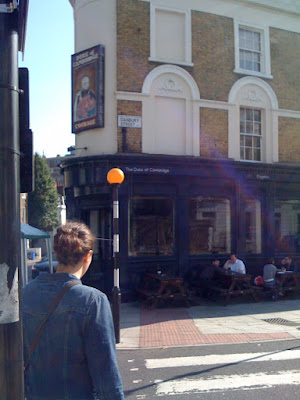
If there can be any such thing as a "pariah gastropub", then it's the Duke of Cambridge in Islington. Opened as the UK's first 100% organic gastropub in 1998 it remains a solid, dependable place for a bite to eat but for some reason has in recent years attracted the kind of vitriolic backlash from foodies normally reserved for £95 burgers or when Delia "goes cheat". Part of the reason could be that while other food pubs in the capital have matured into rustic French restaurants or gone all "St. John" and started serving spleen and chitterlings, the menu at the Duke has remained steadfastly gastropub-traditional and is aimed squarely at wealthy Islington locals - think Feta Salad, mushroom risotto, Italian sausages - safe, comfortable and familiar. Not that there's anything wrong with that in itself, but the problem with limiting yourself to all organic ingredients is that you suddenly find you have to charge £15 for rabbit stew to make the numbers work.
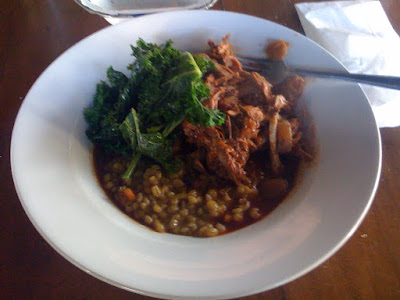
It was a perfectly good rabbit stew - good deep flavours and a nice variety of herbs and veg, if very slightly overcooked rabbit meat and a bit tricky to dissect from the many tiny bones - but all the while there's that nagging knowledge that rabbit is vermin, and a very very cheap meat, and charging £15 for a stew that basically involves chucking the carcass in a big pot with some bay leaves and veg and boiling it for an hour is, well, a bit cheeky.
Fortunately, the reason for my journey to Islington wasn't only to visit the Duke of Cambridge. I was just after something to line my stomach on the way to Beer Exposed, a drinks festival billed as a different approach to beer and beer tasting and organised by an old acquaintance of mine, Des Mulcahy, whom I first met backpacking in Hong Kong all the way back in 2001. He and his colleague Matt Roclawski have scoured Europe and the world for the finest small producers and microbrewers and invited them all to set up shop in London's Business Design Centre to show us ignorant Londoners how beer is supposed to taste.
The contrast with the awful, cynical Toast Festival in Olympia the previous night couldn't have been more stark. On the way into Beer Exposed you are handed a tasting glass, which you use to get free (and often quite generous) samples from all the stalls in the festival. You pay extra for nothing, unless you are so taken with a particular brew you wish to purchase a crate or two to take home. And the range and quality of the drinks on offer at Beer Exposed are so high, and the passion and knowledge of the producers so infectious, that I'm willing to bet that happened quite often during the course of the weekend.

Organised throughout the day were talks and presentations from beer experts on a variety of subjects. We tagged along with a talk about the way hops are used in beers in the UK and abroad. It seems the story of artisan beer has parallels with that of old world and new world wines - namely that Europe started them off, the US took our processes and combined them with their superior raw ingredients, and now we're learning off the Americans and upping our game too. We learned about the International Bitterness Units scale and how different beers use the hops to different effects, balancing them either with a greater alcohol content (the sweet alcohol balances out the bitter hops) or by using a blend of different hops for a more complex taste. It was fascinating stuff.
It's all too easy for these festivals to turn into a corporate brewery trade fair, and the scale of the achievement of Des and Matt in resisting the pressure and money from the big boys and instead creating a gathering of unique, characterful producers is extraordinary. I'm sure that everyone that took the time to visit Beer Exposed has found a new favourite beer - I found about ten, special mentions going to Thornbridge brewery and the porter from Meantime. And if you didn't manage to make it this year, then keep an eye open for next. It'll be a sell-out, in a good way.
The Duke of Cambridge 6/10
Beer Exposed 9/10


